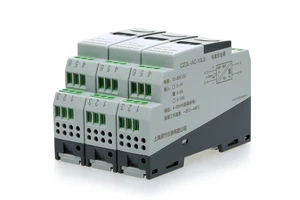
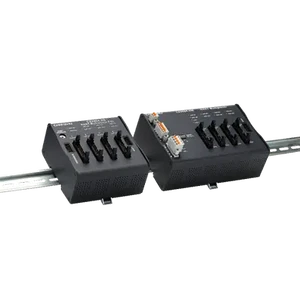
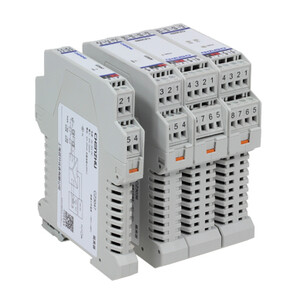
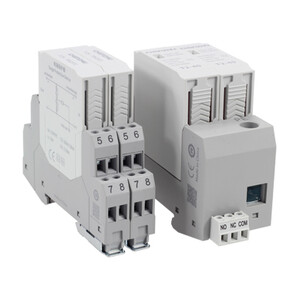
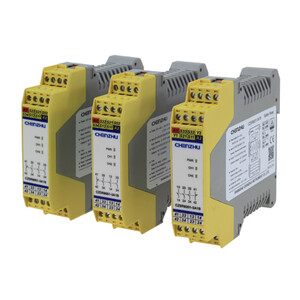
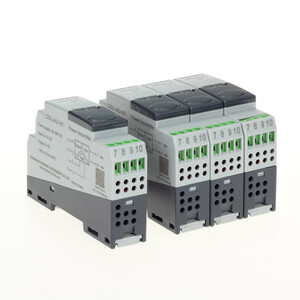
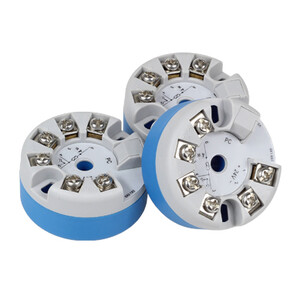
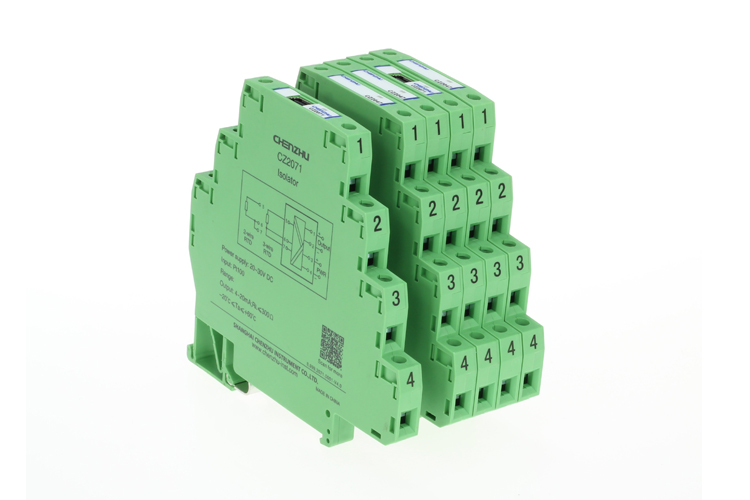
Signal isolator is used to adjust and isolate various signals from field instruments, and convert them into standard signals that can be received by computers, DCS, PLC, etc., or special signals required by users. It can protect the subordinate signal system from being affected and interfered by the superior system.Signal isolator adopts the principle of linear optocoupler isolation, converts the input signal into an output, and achieves mutual isolation among the input, output, and working power supply. Signal isolator is especially suitable for use with equipment instruments that require electrical isolation. It is an electrical device connecting industrial field instruments and the control room, and is also an important component of industrial control systems.
Active signal isolator is powered by an independent power supply to ensure the excellent performance of the isolator. The module requires an active signal on the input side, and on the output side, it provides filtered and amplified signals. Depending on the application, there is mutual isolation among the input, output, and power supply. Active signal isolator includes three-terminal isolation, input terminal isolation, and output terminal isolation.
Three-terminal Isolation
Three-terminal isolation only requires one power supply, which is isolated from the measurement circuit. In modules that use this isolation technology, all components connected to the input terminal, output terminal, or power supply do not interfere with each other, and there is corresponding electrical isolation among the three terminals.
Input Terminal Isolation
Modules using this isolation technology should protect the electronic equipment connected on the output side (such as the input card of the controller) from various interferences on the field. Therefore, the input terminal and the equipotential output terminal and power supply section are electrically isolated.
Output Terminal Isolation
Modules using this isolation technology should protect the electronic equipment connected on the input side (such as the output card of the controller) from various interferences on the field. Therefore, the output terminal and the equipotential input terminal and power supply section are electrically isolated.
Passive signal isolator does not require an additional power supply. The working power of the module is provided by the input or output loop. The current consumed by its internal circuit is minimal and does not affect the correct transmission of the signal. According to the power supply method, passive signal isolator is divided into input side powered, output side powered, and passive feeder isolator.
Input Side Powered
Modules using this isolation technology obtain the required energy from an active input loop (such as an electromagnetic flow meter or control system output card) for signal transmission and electrical isolation. The output side provides processed electricity signals for control or adjustment.
Output Side Powered
Modules using this isolation technology obtain the required energy from an active output loop (preferably the auxiliary power supply from the input card of the control system) for signal transmission and electrical isolation.
Passive Feeder Isolator
Modules using this isolation technology obtain the required energy from an active output loop for signal transmission and electrical isolation, and provide this energy to the passive detection probe connected on the input side (such as a pressure transmitter). The detection probe, using the provided energy, sends an active signal, which is electrically isolated and output through the passive feeder isolator.
A signal isolator is located between the channels of two systems. When choosing an isolator, first determine the input and output functions and ensure that the input and output modes of the isolator (voltage type, current type, loop powered type, etc.) fit the front and back channels. In addition, consider parameters such as accuracy, power consumption, noise, insulation strength, and bus communication function. For example, noise is related to accuracy, and power consumption is related to reliability. All these factors need careful consideration. In short, applicability, reliability, and cost-performance are the main principles for selecting a signal isolator.
 English
 한국어
한국어 français
 Deutsch
 Español
 italiano
 русский
 português
 العربية
 tiếng việt
 čeština