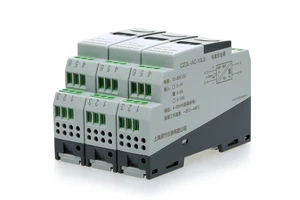
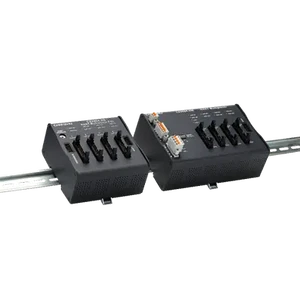
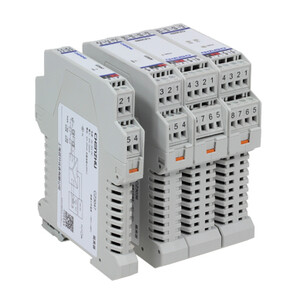
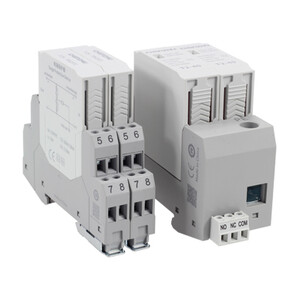
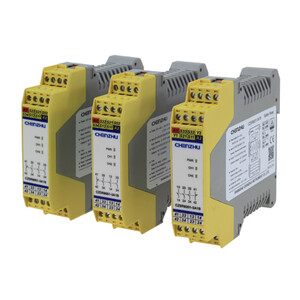
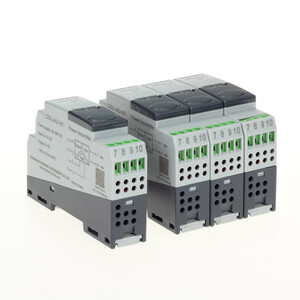
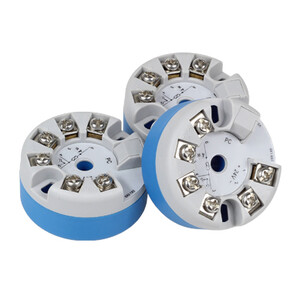
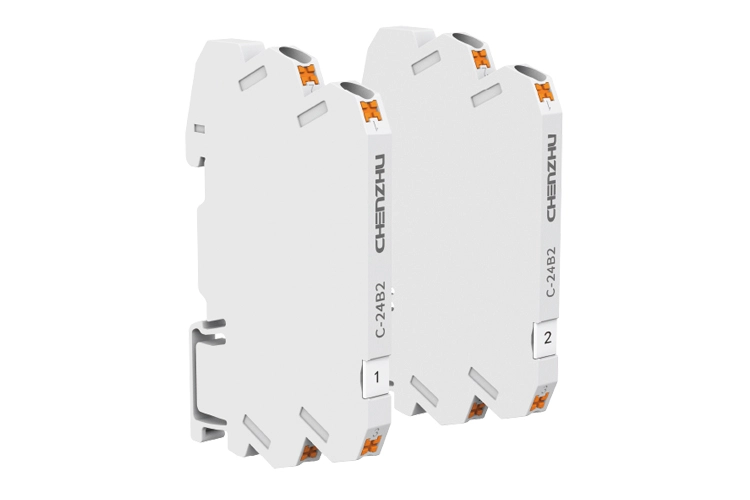
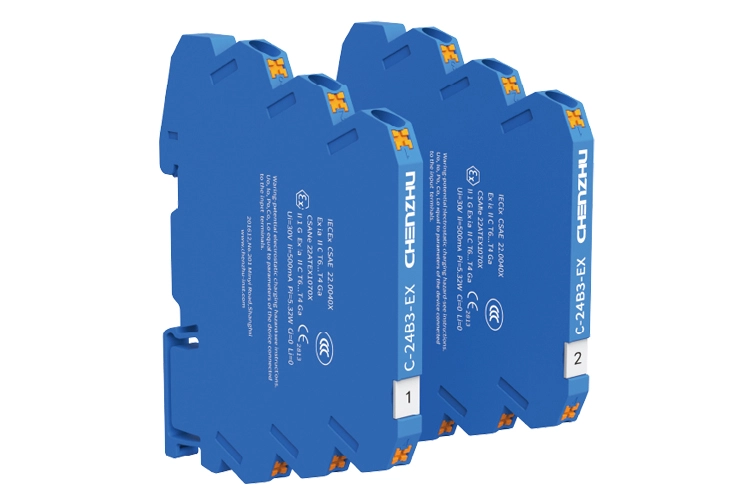
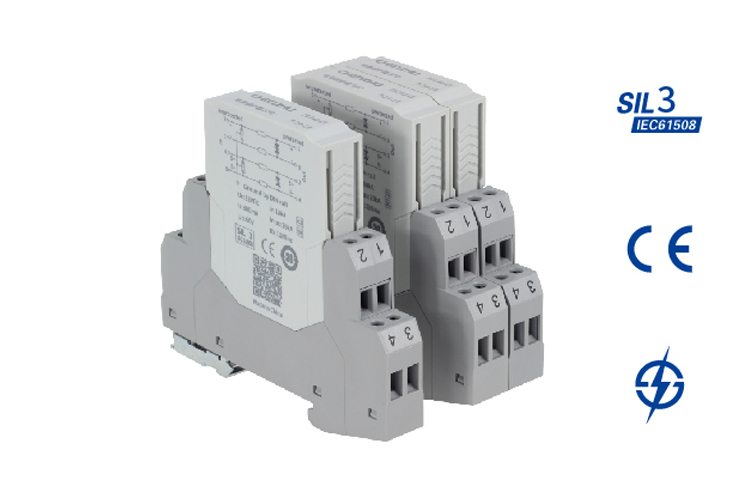
The isolated safety barrier primarily consists of a loop energy limiting unit, a signal and power isolation unit, and a signal processing unit. It not only has energy limiting functions but also isolation functions. There are basically two types of isolated safety barriers: detection-end safety barriers and operation-end safety barriers.
The detection-end safety barrier is used in conjunction with a two-wire transmitter. Through the use of voltage limiting, current limiting, and isolation measures, the isolated safety barrier not only prevents dangerous energy from entering the hazardous site from the intrinsic safety terminals, improving the intrinsic explosion-proof performance of the system, but also enhances the system's anti-interference capability, significantly increasing the reliability of system operation. 24VDC power is converted through DC-AC-DC, outputting the various voltages needed by the module circuits.
An intrinsically safe barrier plays an essential role in petrochemical production.
Adopting a three-way isolation method, there is no need for system grounding lines, which greatly facilitates design and on-site construction.
The signal lines do not require a common ground, which significantly enhances the stability and anti-interference ability of the detection and control loop signals, as well as improves the reliability of the entire system.
It has a good input signal processing capability, capable of accepting and processing signals from thermocouples, thermistors, frequencies, etc.
For instruments in hazardous areas, there are not many requirements, and there is no need to use isolated instruments.
It can output two groups of mutually isolated signals to two devices using the same signal source, ensuring that the signals of these two devices do not interfere with each other, while also improving the electrical safety insulation performance between the connected devices.
The isolated safety barrier has strong signal processing capabilities, such as controlling switch input states, converting mV, Pt100 to 4~20mA, etc. This provides more convenience, rationality, and efficiency to the application of on-site instruments and control systems.
When users are using both DCS and ESD simultaneously, choosing a one-in-two-out safety barrier can effectively isolate the two systems, preventing mutual interference.
Loop-powered isolated safety barriers are easy to wire without the need for an additional 24V power supply, especially suitable for I/O card directly powered DCS systems.
To ensure the optimum performance of an intrinsically safe barrier in petrochemical production, the following key points are critical:
An intrinsically safe barrier needs to meet the explosion-proof grade requirements of the site, ensuring the capacitance and inductance functions of the cables and on-site equipment.
Select an appropriate intrinsically safe barrier according to the signal type of the on-site instrument, to ensure correct transmission and processing of the signal.
Intrinsic safety system equipment needs to use intrinsic safety cables. During cable laying, intrinsic safety cables should be laid separately from non-intrinsic safety cables, and marked with signs to prevent operational errors and signal interference.
The intrinsically safe barrier's applications in petrochemical production not only enhance system safety and reliability but also simplify system design and construction processes. By correctly selecting and using an intrinsically safe barrier, petrochemical enterprises can more effectively prevent explosion accidents, improve production efficiency, and ensure production safety.
 English
 한국어
한국어 français
 Deutsch
 Español
 italiano
 русский
 português
 العربية
 tiếng việt
 čeština