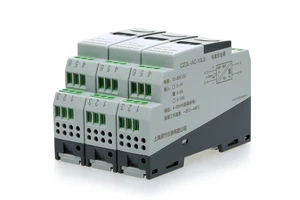
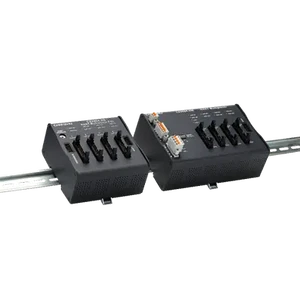
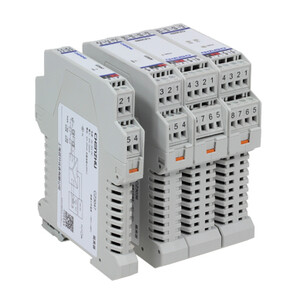
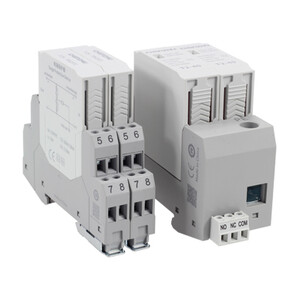
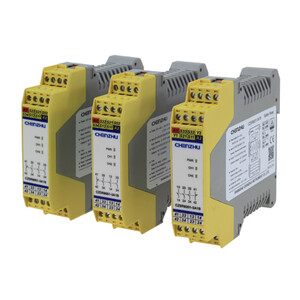
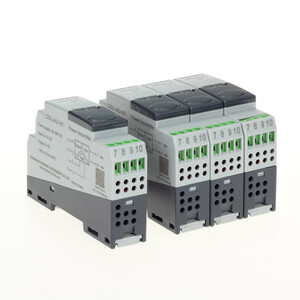
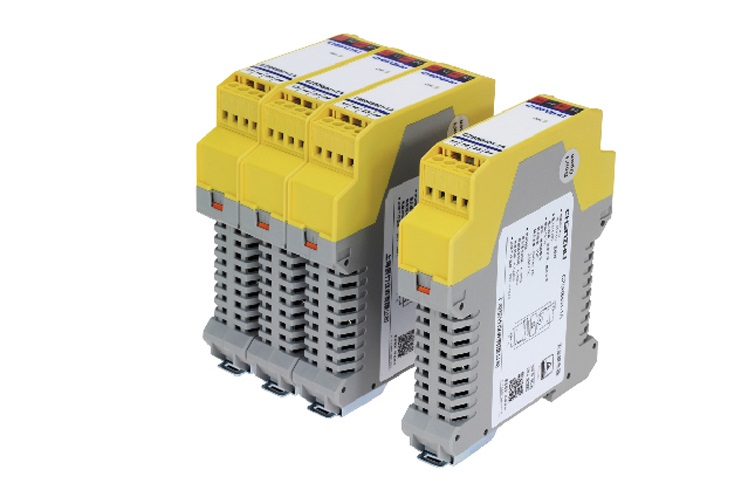
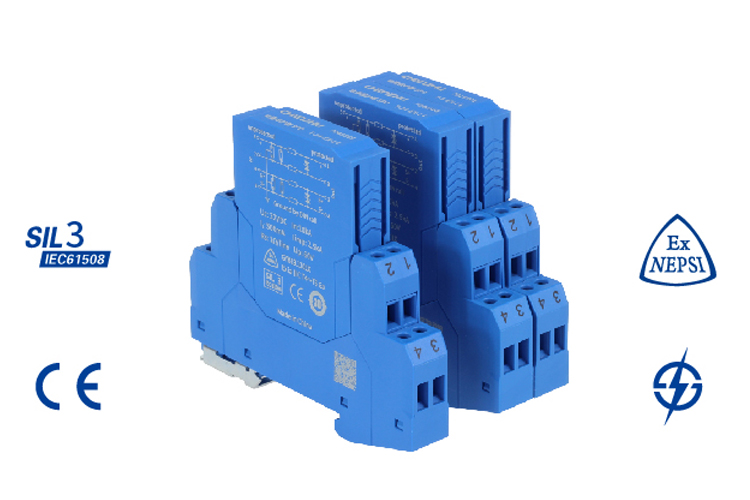
Digital signal isolators use the principle of linear optocoupler isolation to convert and output the input signal. It achieves mutual isolation of input, output, and working power supply. It is especially suitable for industrial equipment and instruments that require electrical isolation, making it an indispensable component in industrial control systems.
Operation of Digital Signal Isolators: The realization of monitoring in industrial production requires the use of various automation instruments, control systems, and actuators. The signal transmission between them can range from weak signals of millivolts and microamperes to strong signals of tens or even thousands of volts and hundreds of amperes. These include low-frequency DC signals and high-frequency pulse signals. When various devices form a system, signal transmission between instruments and equipment often interferes with each other, resulting in system instability or even malfunctions. Apart from the performance reasons of each instrument and equipment, this is due to the potential difference between the signal reference points of the instruments and equipment, forming a "ground loop" that causes distortion during signal transmission. Therefore, to ensure stable and reliable operation of the system, the "ground loop" issue must be resolved in the system signal processing.
Common power supply methods for isolators include independent power supply and loop power supply.
Independent power supply digital signal isolator: require an independent 20~35VDC power supply. The advantage of this method is high isolation transmission accuracy. The power supply, input, and output are completely isolated, and the power supply of multi-channel systems does not need to be isolated. This ensures high anti-interference performance, and the input signal can be converted to other models.
Loop-powered isolators: In practical industrial monitoring systems, the use of card power supplies in DCS, PLC, or other display instruments has become increasingly widespread. Loop-powered isolators retain the superior performance of independently powered isolators while meeting the requirements for loop-powered output interfaces.
Using signal isolation in each process loop can be achieved through isolation cards like those in DCS or PLC, or with isolated field transmitters (some equipment can achieve this), or with digital signal isolators. Compared with these methods, using digital signal isolators has the following advantages: In most cases, it is cheaper to use digital signal isolators and non-isolated cards than using isolation cards. Digital signal isolators are superior to isolation cards in terms of isolation capability and electromagnetic interference resistance. Digital signal isolators are flexible in application, providing model conversion and signal distribution functions, making them more convenient to use. Digital signal isolators are typically available in single-channel, dual-channel, one-input-two-output, etc. The channels are completely independent, making system configuration and daily maintenance more convenient.
 English
 한국어
한국어 français
 Deutsch
 Español
 italiano
 русский
 português
 العربية
 tiếng việt
 čeština